
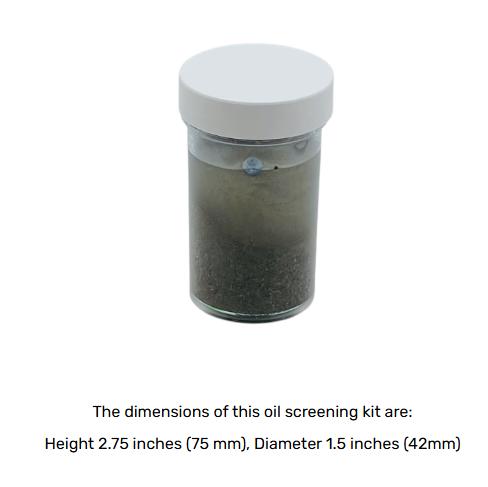
Demeter Enviro LLC Detect Soil-In-Soil COBALT Kit
This product was developed in response to a request for a “non-Sudan IV based” instant oil screening kit that will identify the presence of petroleum products in petroleum contaminated soil, sand and gravel. To provide a maximum visual contrast against dark or red soils this kit stains hydrocarbons and oils a bright royal blue color.
The Detect-Oil-In-Soil (Cobalt) field screening test kit is an inexpensive, simple, and virtually instant qualitative test for identifying the presence of Oils (LNAPLS and DNAPLS) in soil. The only restriction is that the contaminants be sufficiently light in color to ensure the dye can be seen. This product is also suitable for screening TCE, TCA and PCE materials. The soil test kit was designed to overcome the historic difficulties with field screening tests and was therefore developed according to a very specific set of criteria:
1. Detect-Oil-In-Soil (Cobalt) kit is a “go”/”no-go” soil test
kit for the presence of oil (LNAPLs and DNAPLs)
2. The Detect-Oil-In-Soil (Cobalt) test kit will detect
virtually all oils down to approx 500ppm of TPH
3. Detect-Oil-In-Soil (Cobalt) results are immediately
available and require no specialized measurement
equipment
4. Detect-Oil-In-Soil (Cobalt) tests have simple, easy to
read instructions and can be used by utility or industrial
contractors after a couple of minutes training.
How Does the Detect-Oil-In-Soil (Cobalt) Test Kit Work?
Suspected petroleum or DNAPL contaminated soil is added to the sample bottle, to which potable water is also added and the contents shaken vigorously. A rapidly dissolving cube is
attached to the cap. The cube has a blue water-soluble dye disbursed throughout its surface. The blue dye highlights petroleum products or DNAPL by turning them a bright blue. When free petroleum floats to the surface it attaches to an EPS bead that is supplied with the kit and/or attaches to the walls of the container. From concentrations below about 2,500 ppm to the limit of detection (which is about 500 ppm) the EPS bead will turn a pale bluish shade. At very low concentrations we suggest using an used kit as a comparison for the color depth of the EPS bead as the color change may be slight.
The range of detection is approximate because a soil’s affinity for oil will vary. Since DNAPL is heavier than water it is typically seen towards the bottom of the jar. The DNAPL can also be seen as blue “beading” on the sides of the container.
Detect-Oil-In-Soil (Cobalt) Does Not Replace Quantitative Field Screening Tests, However:
During the excavation of contaminated soil, the Detect-Oil-In-Soil soil test kit will permit rapid assessment of the depth and direction of contaminants, thus reducing the time and costs typically associated with field screening methodology.
NOTE: Esters (detergents) are the only known substance to interfere with the dyes ability to stain petroleum
hydrocarbon products. This may be applicable when screening for Ester based (i.e. synthetic) motor oils.
Industries That Would Benefit From Using The Detect-Oil-In-Soil (Cobalt) Kits Include:
Forestry, environmental, aerospace, shipping/marine, railways, manufacturing, petrochemical, utilities, construction and other companies involved with oil leak detection and site remediation
The Detect-Oil-In-Soil (Cobalt) kits are currently used for a wide variety of purposes including:
• Checking for leaks from above ground storage tanks into soil
• Checking for leaks from equipment into soil
• Checking for leaks from utility transformers into soil
• Detecting perimeters, depths and directions of oil spills in soil
• Detecting oil leaks in sumps near tanks
• Detecting chemicals at Dry Cleaner Remediation sites


